
Pool Equipment Glossary
Clear definitions for circulation, filtration, heating, sanitation, plumbing, automation and everyday pool maintenance.
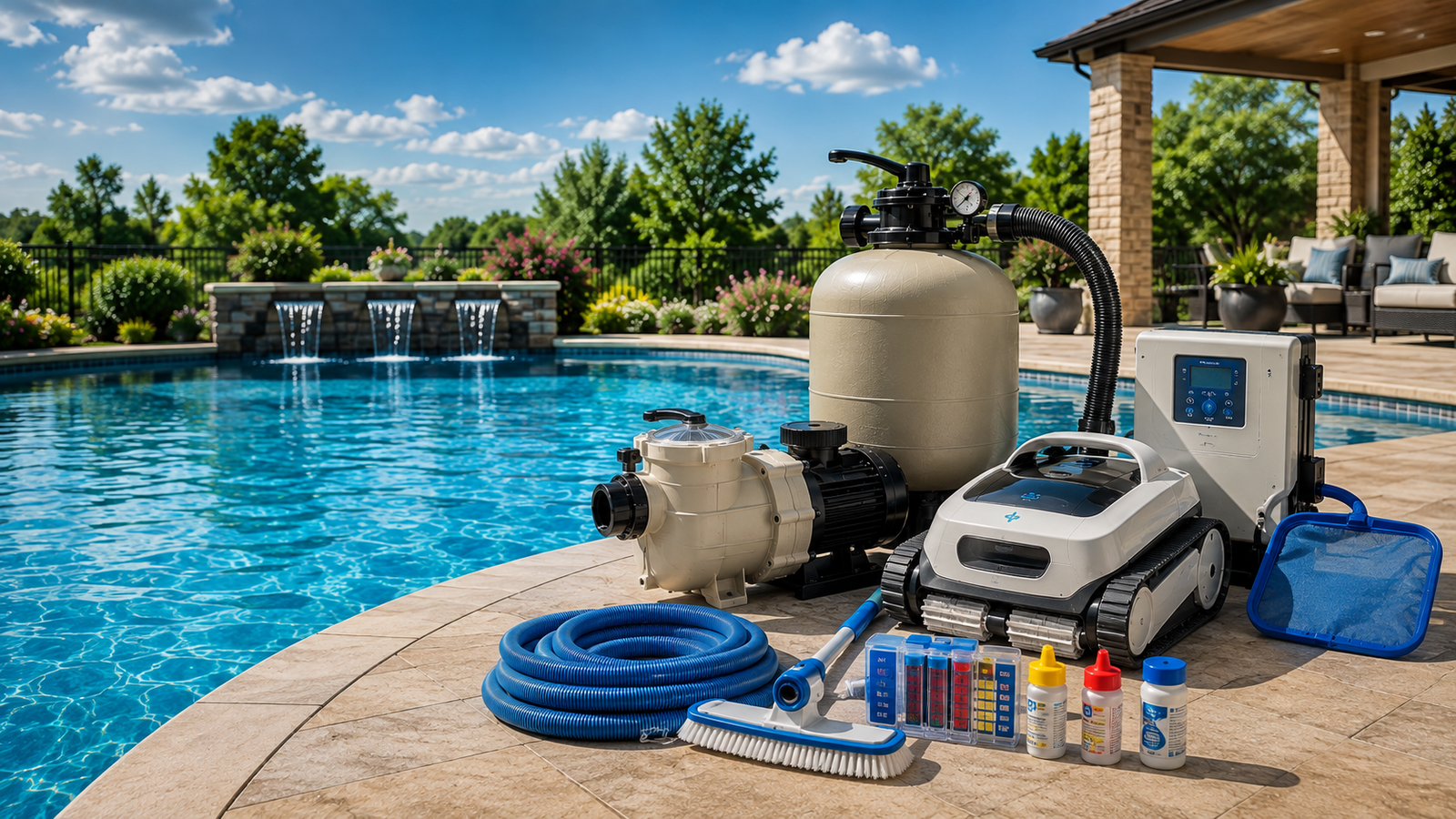
Start with the equipment system
Pool terms make more sense when grouped by the job they perform: moving water, removing debris, adding heat, maintaining sanitizer or controlling flow.
Flow, head and velocity
These terms explain how water moves and why installed pump performance differs from a label maximum.
Sanitizer and balance
Free chlorine, pH, alkalinity, stabilizer and hardness describe different parts of pool-water condition.
Read the manual
Definitions help compare products, but model-specific ratings and limits always come from current manufacturer documents.
Circulation and pumps
Flow rate
The amount of water moving through the system, commonly expressed in gallons per minute.
Total dynamic head
The combined resistance the pump must overcome, expressed as feet of head.
Pump curve
A manufacturer graph showing expected flow at different head values and speeds.
Prime
The water-filled condition that allows many pool pumps to move water properly.
Variable-speed pump
A pump with an electronically controlled motor that can operate at multiple programmed speeds.
Turnover
The theoretical time required to circulate a volume of water equal to the pool volume.
Filtration
Filter area
The effective surface area of the filter media, usually stated in square feet.
Micron
One-millionth of a meter; used to describe particle size, not a complete measure of real-world filter performance.
Backwash
Reversing water flow through certain filters to carry trapped debris to waste.
DE filter
A filter that uses diatomaceous earth or an approved alternative as a fine filtration medium.
Cartridge filter
A filter using removable pleated elements that are cleaned outside the tank.
Sand filter
A filter that passes water through a bed of pool-filter sand or approved media.
Heating and energy
BTU
British thermal unit; the energy needed to raise one pound of water by one degree Fahrenheit.
Heat pump
A heater that transfers heat from ambient air into pool water.
Coefficient of performance
A ratio comparing heat delivered with electrical energy consumed by a heat pump under stated conditions.
Heat exchanger
The component that transfers heat from a combustion or refrigeration system into pool water.
Thermal efficiency
The share of fuel input converted into useful heat output for the water.
Evaporation loss
Heat carried away when surface water changes to vapor, often a major source of pool heat loss.
Sanitation and water care
Free chlorine
Chlorine available to disinfect water, measured separately from combined chlorine.
Combined chlorine
Chlorine that has reacted with contaminants; often associated with chloramines.
Cyanuric acid
A stabilizer that reduces sunlight degradation of chlorine in outdoor pools.
Total alkalinity
A measure of the water’s capacity to resist rapid pH change.
Calcium hardness
The concentration of dissolved calcium measured as calcium carbonate equivalent.
Salt chlorine generator
A system that produces chlorine from dissolved salt through electrolysis.
Plumbing and controls
Check valve
A one-way valve intended to prevent reverse flow.
Jandy-style valve
A common diverter-valve design used to direct flow between pool plumbing branches.
Union
A fitting that allows equipment to be disconnected without cutting pipe.
Bonding
Connecting conductive pool components together to reduce voltage differences; it is distinct from grounding.
Automation system
Controls that schedule and coordinate pumps, heaters, lights, valves and sanitizing equipment.
Freeze protection
A control strategy that runs equipment during low temperatures; it does not guarantee protection during outages or severe weather.
Pool terminology questions
What is the difference between flow and pressure?
Flow describes how much water moves over time, while pressure reflects force within the system. They are related through the system’s resistance but are not interchangeable.
What does total dynamic head mean?
It is the combined hydraulic resistance seen by the pump, including pipe friction, fittings, equipment and elevation effects.
Is turnover the same as filtration quality?
No. Turnover is a theoretical circulation calculation. Filtration quality also depends on mixing, filter media, flow, maintenance and particle characteristics.
What is the difference between bonding and grounding?
Bonding connects conductive pool components to reduce voltage differences. Grounding provides a fault-current path to the electrical system. Pool electrical work should follow code and be performed by qualified professionals.
Why are BTU input and output different?
Input describes fuel energy supplied to a heater, while output is the useful heat delivered after efficiency losses.
Does a saltwater pool contain chlorine?
Yes. A salt chlorine generator converts chloride in dissolved salt into chlorine sanitizer.
What is the difference between free and combined chlorine?
Free chlorine is available for disinfection. Combined chlorine has reacted with contaminants and is measured separately.
Why do manufacturer definitions matter?
Terms such as maximum flow, design flow and heating capacity are tied to test conditions. The product manual is the source of truth for a specific model.
Related pool resources
Use terms in context
A familiar term can have a precise model-specific meaning. Check the current manual, engineering data and local requirements before sizing, installing or changing equipment.